
When you select to define a prior distribution on a fixed effect, a new window will open to define its law as in the following
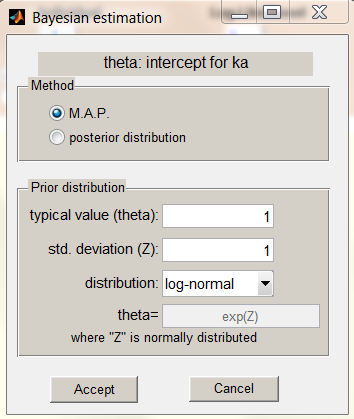
As for individual parameters, you can choose from some given distributions (normal, log-normal, logit-normal and probit-normal) or you can define your own as a transform T of a Gaussian distributed variable.
Assuming 





Notice that Monolix can estimate the M.A.P only for
- gaussian priors if the parameter is a covariate coefficient (a “
”)
- priors with same distribution than the corresponding individual parameter if
is an intercept. It means that if V is set as log-normal distributed, then the M.A.P of
) can only be computed for log-normal priors on
 ”)
”) ) can only be computed for log-normal priors on


